Fieldnote / Woest · 2026
Fieldnote
Privacy-first health tracking, shipped solo. Two products, an iOS Capacitor wrapper, and a shared-layer architecture that ships a third app in a folder-add.
- Products shipped
- 0
- FODMAP versions
- 0
- Specs written
- 0
- Food database
- 0
- Menopause symptoms
- 0
- Servers
- 0
- Files per app
- 0
- Lifetime price
- $12
Process
The architecture that fixed AI-assisted editing
Source → build → deliverable
The original FODMAP app was one HTML file — source of truth and customer deliverable at the same time. Editing it with Claude Code kept producing rewrites, not edits. The fix was to put the complexity in the right place: an explicit build step.
"A build step puts complexity in the right place — explicit and controlled rather than implicit and fragile."
The new shape: src/[app]/ folders with one concern per file (db, parser, lib, state, ui-log, ui-history, ui-insights, ui-settings). A build script reads template.html with {{PLACEHOLDERS}}, injects each file in a known order, writes a single dist/<app>-vX.X.XX.html that's identical to today's customer deliverable.
Behavioural result: AI edits are now surgical. Database changes happen in db.js without touching UI. Demo data lives outside the app build and never accidentally ships to customers. Each file under ~500 lines so the full context fits comfortably in a single AI conversation.
Architecture for 10+ apps with zero shared-code edits per new app
A shared layer that holds while apps stay independent
Once a second app (Menopause Companion) was on the horizon, every concept either lived in shared/ once or was app-specific. The principles, lifted from the architecture spec:
- Shared code lives once. No duplication across apps.
- Apps own their schemas. Data structure is app-specific.
- Standard build order. Every app uses the same injection sequence.
- CSS tokens, not values. Shared components consume CSS variables; apps define the values. Zero changes to shared CSS per new app.
- Config-driven components. UI takes config objects. No app-specific logic inside shared components.
- Food DB: identity in shared, condition layers in app. Pure food identity (name, macros, aliases) is shared. FODMAP levels, trigger evidence, histamine ratings live in each app's db.js.
Adding a third app means creating a new src/[app]/ folder. No edits to shared code.
Capacitor 6 + an async storage layer that switches at runtime
Going native without rewriting
The PWA had to also be a real iOS app — App Store presence matters for trust, even if everything else is browser-first. Capacitor 6 wraps the same single-file HTML in a WKWebView shell.
Storage was the hard part. localStorage is volatile under iOS WKWebView; data needs to survive app kill and reinstall. The fix: a createStore() factory in shared/storage-lib.js that detects the Capacitor runtime at startup and routes reads/writes through @capacitor/preferences (UserDefaults) on iOS, falling back to localStorage on web. All store.* methods became async.
Native polish followed: position:fixed header behind the Dynamic Island, env(safe-area-inset-*) on every sticky element, native <input type="time"> instead of a custom picker, navigator.share({files:[...]}) for backup export, full-width toasts above the bottom tab bar, momentum scrolling.
Marketing the apps requires showing them — so the demo data has to be real
Demo data as a first-class system
The marketing site runs full working apps inline, pre-loaded with 31 days of realistic data. The demo dataset is its own spec: not a stripped-down sample but a coherent 31-day arc that produces meaningful Insights and a sensible Report on first view. demo-data.js is a build-time injection — never shipped to customers, always present on fieldnote.health/demo/*.
Side effect: writing the demo data is the strongest UX check you can do. If the data doesn't produce a story across 31 days, the Insights tab probably has the wrong axes.
The substance that stayed under human control
What AI didn't decide
The point of an AI-paired workflow isn't that the AI is in charge. The point is to push the boring work into a system so the substantive decisions get more attention. On Fieldnote those decisions were:
- The FODMAP database. Monash's public dataset has gaps and ambiguities for ingredient-level use (the canonical use case is per-meal serving size). Remediating that for actual home cooking — what counts as a serving of "garlic", whether "spring onion green" is the same as "spring onion white", how to handle blends — was 40+ hours of hand-curation. No AI shortcut.
- Consumer copy. "Hot flashes" not "vasomotor symptoms". "Doctor-ready report" not "clinical export." Every screen of every product had this pass. AI drafted, the brand voice cut.
- Brand direction. Cream-on-warm-paper palette, slab serif wordmark, illustration-led packaging on Etsy. Quiet, deliberate, doesn't look like another health app.
- Pricing. $12 lifetime. Not $4/month, not $79/year. The number that pays for the design without insulting the user. AI doesn't have an opinion on this; the founder does.
"Each tool is a single file that runs in your browser. Your data is stored on your device. Buy it once. You own it."
Deliverables
Ingredient-level logging with a 180+ food database
FODMAP Tracker
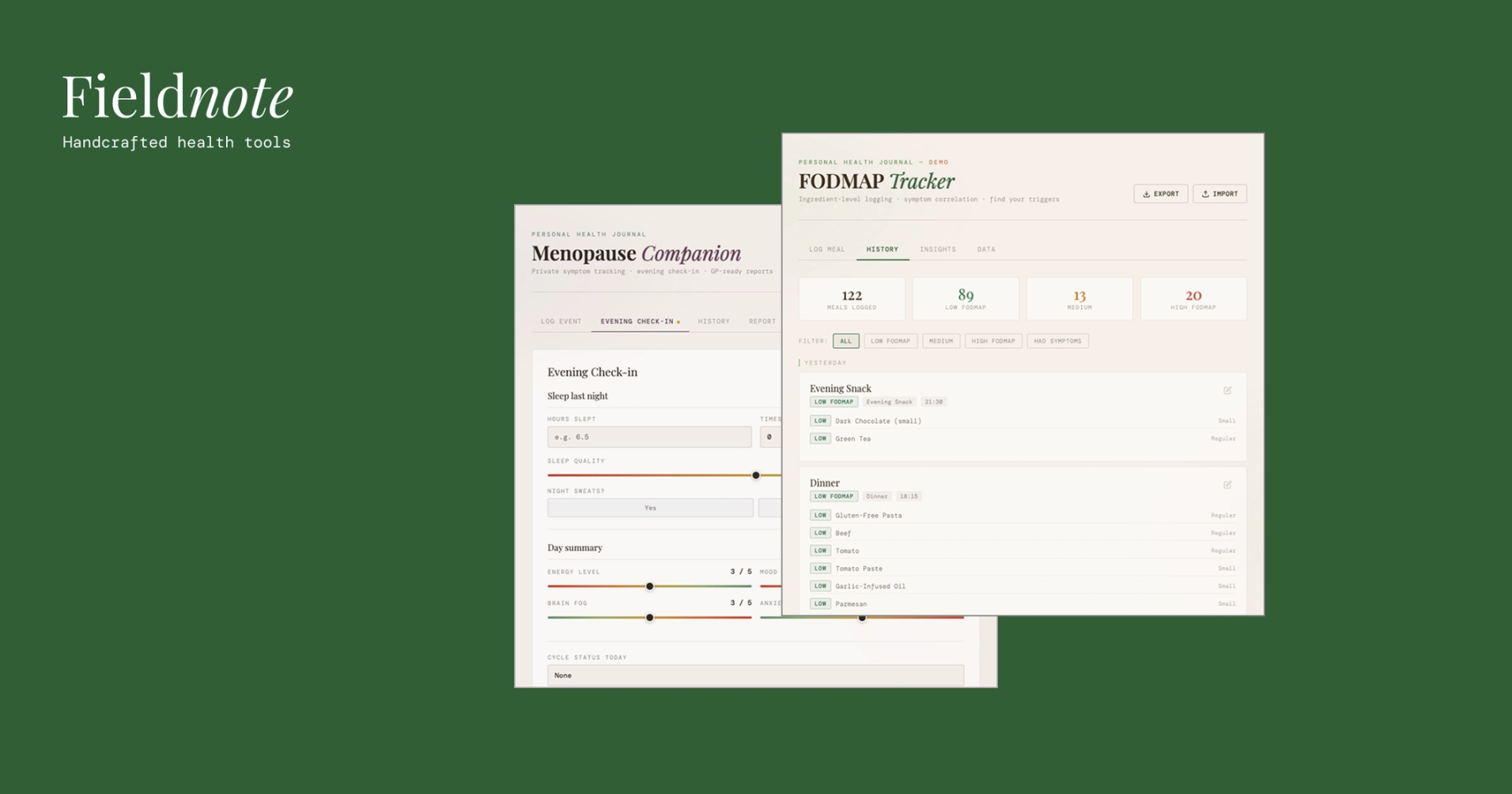
The first product. For people managing IBS via the FODMAP elimination diet. Type ingredients in plain language, the parser resolves them against the food database, FODMAP load auto-calculates per meal and per day. Symptom logging on the same screen. Patterns surface in Insights.
Browser-based, single HTML file, native iOS wrapper. Backup as JSON. Print a Doctor-ready report. $12 lifetime.
Event-based logging across perimenopause, menopause, postmenopause
Menopause Companion
The proof-of-architecture. Built on the shared layer after the FODMAP foundation hardened. 12 symptom types (hot flashes, night sweats, mood shifts, brain fog, anxiety, palpitations, joint pain, more). Evening check-in for mood / energy / sleep / cycle. Generates a GP-ready report with appointment questions compiled from the logged data.
Same architecture as FODMAP, fully different data model. Same $12 lifetime price. The new product was a folder-add, not a refactor.
The output that justifies the logging
GP-ready report
Both products generate a printable report compiled from the user's logged data. Designed to be handed to a doctor at the start of a 12-minute appointment — pre-summarized symptom patterns, appointment-question prompts, no jargon. The deliverable that lets the user feel the value of having logged at all.
Patterns surface from data the user already logged
Insights tab
The "why I bothered logging" tab. Symptom frequency, trigger candidates, week-over-week trends, time-of-day patterns. Pulls everything from local storage — no recommendations engine, no fake confidence. Just signal that's actually in your data, written so a non-clinician can read it.
fieldnote.health — Next.js, full working apps inline
Marketing site + demo
A separate Next.js marketing site at fieldnote.health. The clever bit: each product page includes a working live demo of the actual app, pre-loaded with 31 days of realistic data. Try-before-you-buy literally means using the product before you buy it.
Same build pipeline produces both the customer .html download and the demo build embedded on the marketing site. One source tree, three outputs (web demo, iOS Capacitor, customer download).